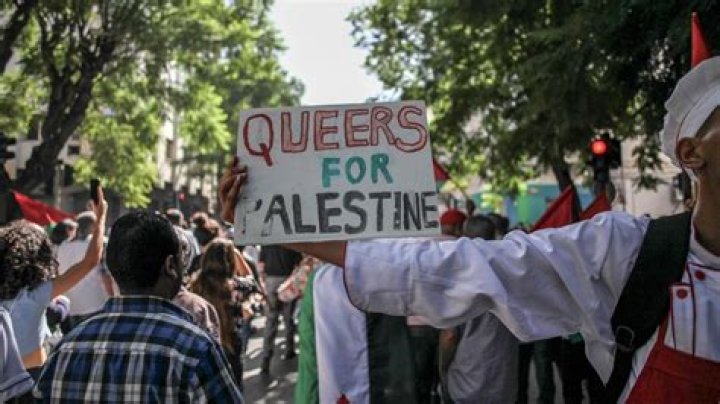
Dr. Sa'ed Atshan, a professor of Anthropology and Peace and Conflict Studies at Swarthmore College, has spent much of his life and career thinking through these issues. His 2020 book Queer Palestine and the Empire of Critique is a close look at the necessity of connecting the struggle for Palestinian freedom with the struggle against homophobia and transphobia within the occupied territories.
We asked Dr. Atshan for his perspective on the rise in queer solidarity with Palestinians, the arguments against it, and how to make sense of the current moment.
What was it like growing up in the West Bank?
I spent [my] childhood years in the West Bank, in Ramallah, and growing up under Israeli military occupation. On one hand, there's a tremendous amount of beauty and joy in living in Palestine: the people, the landscape, the generosity of spirit, the food, the love, the community, the sense of solidarity, the traditions being really held in a collectivist society and space. There was just a lot of beauty. Picking olives during the olive harvest season. I don’t know if you’ve ever had the experience of picking a fresh fig off the tree; it’s just amazing.
So, I feel deeply connected and rooted there, and my ancestors are from there, and the spirits of my ancestors are with me. But at the same time, there is oppression and there is suffering and there are soldiers and there are Israeli settlers and there are roadblocks and there are systematic denials of our fundamental basic human rights and our civic political rights and our socioeconomic rights. These are the realities. You have the former and the latter, and somehow, you have to just navigate these dynamics.
How would you contextualize this moment that we're in right now, in particular with respect to queer solidarity with Palestinian civilians?
I think that what we’re witnessing now on the ground in Palestine runs along a continuum of what’s been happening for over 75 years now, of Israeli settler colonialism and military occupation and apartheid and different forms of ethnic cleansing. But at the same time, what we’re seeing is truly unprecedented in terms of the scale of the killing of Palestinian civilians, as well as the denial of access to water and electricity and power and medicine, on a scale in Gaza that is absolutely horrifying and very, very, very difficult. And similarly, what happened on October 7th in Israel, after the horrific attacks and massacre by Hamas, also exists along a historical continuum. This is not the first time that Palestinian armed groups have deployed violence against Israeli civilians. There’s a history, unfortunately, of suicide bombings, but the scale of the killing of Israelis is unprecedented. [Although] I want to be clear that there’s a profound asymmetry in power and a profound asymmetry in the loss of life between Israelis and Palestinians.