| Life Cycle: Eggs, Larvae, Pupae, Eclosion |
An understanding of the life cycle and general biology of lepidoptera adds much to the overall experience of moth photography. There is an excellent on-line syllabus and illustrated Entomology Tutotial Series offered by North Carolina State University. This is a fine resource for your use in finding answers to many puzzling questions about the insects you encounter. I thank Professor John R. Meyer in the Deptartment of Entomology there for permission to reproduce below a portion of the chapter dealing with holometabolous development. |
![]() |
Holometabolous insects have immature forms (larvae) that are very different from adults. Larvae are "feeding machines", adapted mostly for consuming food and growing in size. They become larger at each molt but do not acquire any adult-like characteristics. When fully grown, larvae molt to an immobile pupal stage and undergo a complete transformation. Larval organs and appendages are broken down (digested internally) and replaced with new adult structures that grow from imaginal discs, clusters of undifferentiated (embryonic) tissue that form during embryogenesis but remain dormant throughout the larval instars. The adult stage, which usually bears wings, is mainly adapted for dispersal and reproduction.
| |
| Appearance | Larval Type | Common Name | Description | Examples | ![]() | Eruciform | Caterpillar | Body cylindrical with short thoracic legs and 2-10 pairs of fleshy abdominal prolegs | Butterflies and Moths | ![]() | Vermiform | Maggot | Body fleshy, worm-like. No head capsule or walking
legs | House fly, flesh fly | | Appearance | Pupal Type | Common Name | Description | Examples | ![]() | Obtect | Chrysalis
Pupa | Developing appendages (antennae, wings, legs, etc.) held tightly against the body by a shell-like casing. Often found enclosed within a silken cocoon. | Butterflies and moths | ![]() | Coarctate | Puparium | Body encased within the hard exoskeleton of the next-to-last larval instar | Flies | |
| Holometabolous Development data from ENT 425 Tutotial Series at NC State University © Professor John R. Meyer, Dept. of Entomology |
| Eggs |
| |
| Larvae or Caterpillar Stage |
![]() Imperial Moth - Eacles imperialis Imperial Moth - Eacles imperialis
1st instar - © Stuart Schwartz | ![]() Imperial Moth - Eacles imperialis Imperial Moth - Eacles imperialis
early 5th instar - © Stuart Schwartz | ![]() Luna Moth - Actias luna Luna Moth - Actias luna
color forms - © Stuart Schwartz | ![]() Io Moth - Automeris io Io Moth - Automeris io
group behavior - © Machele White | |
Larvae may go through four, five (usually) or more instars during development. This may require several weeks or months and even several years in a few cases. Coloration and markings may change significantly from instar to instar. In some species there may be distinctive color forms in the larvae even when they originate from the same egg mass/parentage.
|
![]() Royal Walnut Moth - Citheronia regalis Royal Walnut Moth - Citheronia regalis
early instar - © Troy Bartlett | ![]() Royal Walnut Moth - Citheronia regalis Royal Walnut Moth - Citheronia regalis
intermediate instar - © Troy Bartlett | ![]() Royal Walnut Moth - Citheronia regalis Royal Walnut Moth - Citheronia regalis
late instar - © Troy Bartlett | |
![]() 5-spotted Hawkmoth - Manduca quinquemaculata 5-spotted Hawkmoth - Manduca quinquemaculata
black form - © Jim McClarin | ![]() 5-spotted Hawkmoth - Manduca quinquemaculata 5-spotted Hawkmoth - Manduca quinquemaculata
green form - © Janice Stiefel | ![]() 5-spotted Hawkmoth - Manduca quinquemaculata 5-spotted Hawkmoth - Manduca quinquemaculata
black form - © Bryan Reynolds | |
| Cocoon and Pupa/Chrysalis |
![]() a. - © Joyce Gross a. - © Joyce Gross | ![]() b. - © Pete Ganzel b. - © Pete Ganzel | ![]() c. - © Charles Lewallen c. - © Charles Lewallen | ![]() d. - © John Himmelman d. - © John Himmelman | -
Cocoon containing corpse of a Western Tussock Moth pupa and, beside it, the puparium of a parasitoid Tachinid Fly. -
A well crafted silk cocoon of the Cecropia Moth, Hyalophora cecropia. -
A Bagworm Moth case used for protection during the larval phase, it serves also as a pupation site. Wingless females never leave the case. In this instance a male has eclosed to adulthood leaving behind the puparium or exuvium now projecting from the tip of the case. It will locate a female when she releases a pheromone attractant, and mate with her through a small opening in her protective case. -
Numerous micromoths are known as casebearing moths and utilize diversely designed cases in which to pupate. This is the Pistol Casebearer Moth, Coleophora atromarginata, named after the shape of its case. | ![]() e. - © Machele White e. - © Machele White | ![]() f. - © Machele White f. - © Machele White | ![]() g. - © Machele White g. - © Machele White | ![]() h. - © Machele White h. - © Machele White | -
Cocoon of the Southern Tussock Moth, Dasychira meridionalis, richly lined with the caterpillar's hairs added to the silken enclosure. -
Wingless female of the Live Oak Tussock Moth, Orgyia detrita with her eggs on top of the cocoon from which she eclosed. Here we have three life stages in a single photo. She will probably cover the egg mass with a frothy protective coating. -
Some species use little or no silk to conceal their pupation site, especially when it is their custom to pupate in leaf litter. This is the Bella Moth, classified here as part of the complex species Utetheisa ornatrix. -
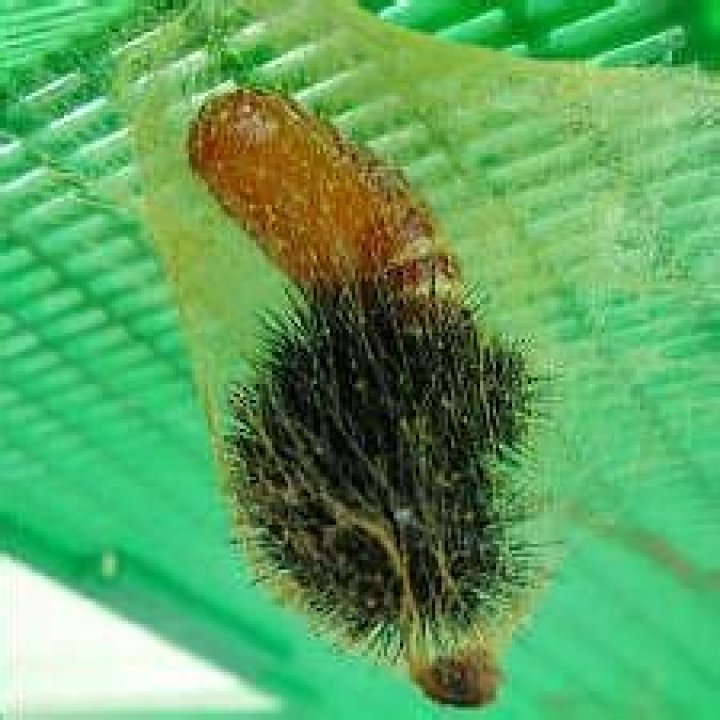
Frequently, skin of the last instar caterpillar is found in the cocoon with the pupa. In this case the caterpillar of a Giant Leopard Moth, Hypercompe scribonia did not incorporate its body hairs into the cocoon. The brown puparium seen here will blacken prior to eclosure. | |
![]() i. - © Tim Dyson - Sphinx kalmiae i. - © Tim Dyson - Sphinx kalmiae | ![]() j. - © Alan Chin-Lee - Manduca rustica j. - © Alan Chin-Lee - Manduca rustica | ![]() k. - © Alan Chin-Lee - Erinnyis ello k. - © Alan Chin-Lee - Erinnyis ello | -
Pupae Jewels found in leaf litter. Laurel Shinx Moth in Ontario. -
Rustic Sphinx Moth in Florida. -
Ello Sphinx Moth in Florida. | |